Sunday, August 5, 2012

Rambling in Sweden/Arrival in Oslo: July 24-28, 2012

TUESDAY, JULY 24, 2012

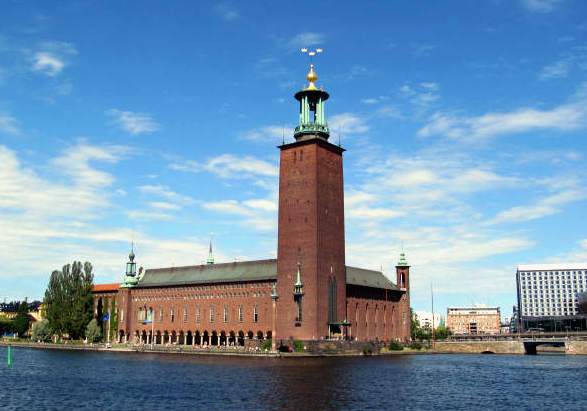
Mari-Anne and I took the train in to Stockholm this morning. Sweden has an excellent public transportation system in this area with frequent trains in and out of town. We got off in the city center, then headed to City Hall for a tour--and what a place it is. Every bit as interesting as the guide book says it is! Construction took 12 years, 8 million bricks, and 19 million gilded mosaic tiles. A process was used to make the bricks appear to be older than they actually are. The tour began in the Blue Room, which is where the dinner is served for Nobel Prize winners (except the Nobel Peace Prize which is awarded in Oslo), and continued throughout the building. The Gold Room was particularly impressive with its gold mosaic tiles.
Mari-Anne by Stockholm City Hall
Below:  The Blue Room

Gold Room

Gold Room
We continued our walking tour on to Gamla Stan (Old Town) where we passed the Swedish Parliament building and the Royal Palace (the King's official address although he prefers to live elsewhere) where we caught the end of the changing of the guard. The Palace dates mostly from the mid-1700s after a fire.
Sweden's Parliament Building
We walked on through the streets of Old Town which is a charming area with many old buildings, narrow streets, interesting shops, and lots of languages being spoken. Mari-Anne knows the area well and picked out a nice place to enjoy lunch outdoors on this beautiful sunny day. I would never have found it myself--it really helps to have someone guide you who knows an area intimately! She also helped maneuver me through the local customs in a place such as this.

Ancient fountain in Gamla Stan

Gamla Stan


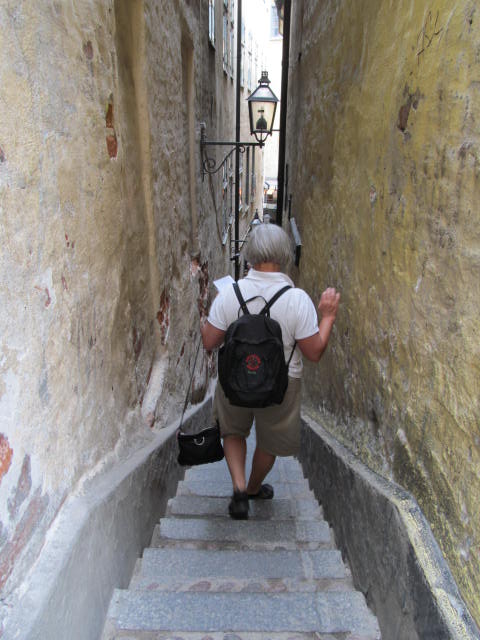
Marten Trotzigs Alley--Narrowest Alley in Stockholm at 35.4" at its narrowest

Marten Trotzigs Alley
Western Store in Gamla Stan!
We visited the Stockholm Cathedral (Lutheran denomination) which was commissioned in the mid-13th century--parts of the foundation under the vestry date from this period. The earliest written mention of the church is dated 1279 and the oldest parts of today's brick church were consecrated in 1306. Changes/additions were subsequently made and the church reached its current size as a five-aisled church in the 1480's. There are many old paintings and sculptures in it dating back to the 17th century, but the highlight was to look at the "St. George and the Dragon" sculpture commissioned in 1489 and carved out of oak with materials such as elk antlers and horsehair used for details.

Stockholm Cathedral
St. George and the Dragon
Stockholm (current population of about 2 million) was founded over 7 centuries ago and was built on 14 islands in Lake Malaren. It marks the beginning of an archipelago of over 24,000 islands that stretch to the Baltic Sea. The city became the official capital of Sweden in the mid-1600s. Sweden is about the size of California. All too soon it was time to draw this walking tour to an end for the day--but we will return.

Upon returning to the Stignas home, Mari-Anne set about preparing a delicious dinner. She had prepared a moose roast that was slow-cooked for many hours--and it was delicious. Undoubtedly, this was the best moose that I have ever eaten! Gunnar and Mari-Anne's daughter, Maria, and granddaughters, Emma and Anna, joined us and we had a nice visit. I had met Maria previously in AZ and it was nice to re-connect. It was also nice to meet Emma and Anna and hear about their activities. This ended a very full and satisfying day!

JULY 25 AND 26, 2012

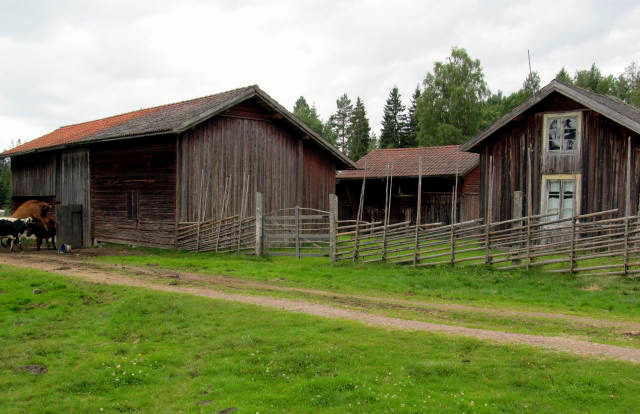
We were up early and, after another of the Stignas' bountiful breakfasts, we set off on a driving tour of the Dalarna area of Sweden located northwest of Stockholm. We drove past many farms with large barns and numerous outbuildings. Crops consisted of small grain such as oats, wheat, rye, etc., but no corn. A lot of hay is baled and stored in white plastic wrap. The hay ferments in the plastic and is used for silage. Some cows and sheep were spotted on the trip, but no significant numbers in a herd. Gunnar said many of the farm buildings we passed were 200 or more years old. Buildings and yards were neat--it is clear the people take pride in their farms and homes.
Farm a short distance north of Stockholm
Farm in Dalarna
Typical buildings in Dalarna region


Maypoles in Dalarna Communities

It's time for a coffee break!
Our first stop was near Avesta where we ate snacks and drank coffee that Mari-Anne had brought while observing the large "Dala" horse statute.

The Dala Horse welcomes visitors to Dalarna
The Dala horse is a traditional piece of artwork from this area and is frequently painted orange with white, turquoise, and blue floral designs. It is very colorful and representative of this part of Sweden--Mari-Anne had sent me one when we corresponded years earlier, which I still have. Oh, yes, there was a geocache nearby so we got in a stretch break as we looked for it--and found it.


Mari-Anne, Elizabeth, & the 2 Gunnars
We continued our drive northwest to see their friends, Gunnar and Elizabeth, at their summer home on a lake. It is a beautiful location and the property has been in the family for generations.


Traditional Swedish fencing method used on Gunnar's property

One building that Gunnar had beautifully restored dated back to the 1600s as evidenced by the way the logs were cut.


Gunnar's restoration project (Absolutely Beautiful!)
After another bountiful lunch, we all went to nearby Ljusbodarna, an "open air museum ". This was a very old set of buildings that had been used many years ago by young girls who tended livestock (mostly cattle) that had been moved to the mountains during the summers. The first mention of this location was in 1663, but it is much older than that. The girls lived and worked here during the summer season caring for the cows, processing the milk products, etc.
Ljusbodarna Open Air Museum


Notice how short the bunk beds are!


Traditional method of drying hay (still in use in Scandinavia)


After good-byes were said, we continued our drive north to Mora (about 200 miles northwest of Stockholm), then southeast to Falun.

Farm deep in the heart of the Dalarna region
This leg took us most of the way around Lake Silijan which is described in one guidebook as possibly the most beautiful lake in Europe. It truly is a beautiful lake where many of the area's traditions are still carried out.

Lake Silijan


We examined a "church boat" which is a type of long boat from Viking times that is still used to carry parishoners across the lake on Sundays in the summer. Use of the boats dates back to the 11th century and they could carry up to 80 people with 10 to 12 pairs of oars used to propel the boat. When christianity came to this part of the world people "had to go" to church and the boats were used for hundreds of years since roads were almost impassable.

Church Boat at Lake Silijan

We also stopped at a Dala horse factory and it was interesting to see the steps used in the process of producing these unique articles.

Dala Horse Factory


A final stop in the evening was at an area where a meteorite hit many years ago forming some of the land forms in this area, including Lake Siljan. We enjoyed a walk along a creek that had an awesome waterfall as well as very unusual geologic formations.

Map showing general land area impacted by meteorite about 360 million years ago
It was late when we stopped at the Scandic Lugnet hotel which is next to a large ski area in Falun (chartered in 1641), bringing to end a most interesting day.

Scandic Lugnet hotel (note windows in shape of a ski jump)

Winter sports complex at Falun
We were up early on the 26th for another full day as we headed back towards Jakobsberg. We began with a tour into the underground shafts of the copper mine at Falun, now a UNESCO World Heritage Site, dating back over 1,000 years. It is unknown exactly when ore began to be taken from the mine; however, by the 13th century its significance to the national economy was well established. Copper mining activity was shut down in 1992, but an Australian company is currently exploring to determine if enough gold is here to make mining it worthwhile.
Falu Kopparbergsgruva
(Copper Mountain Mine)
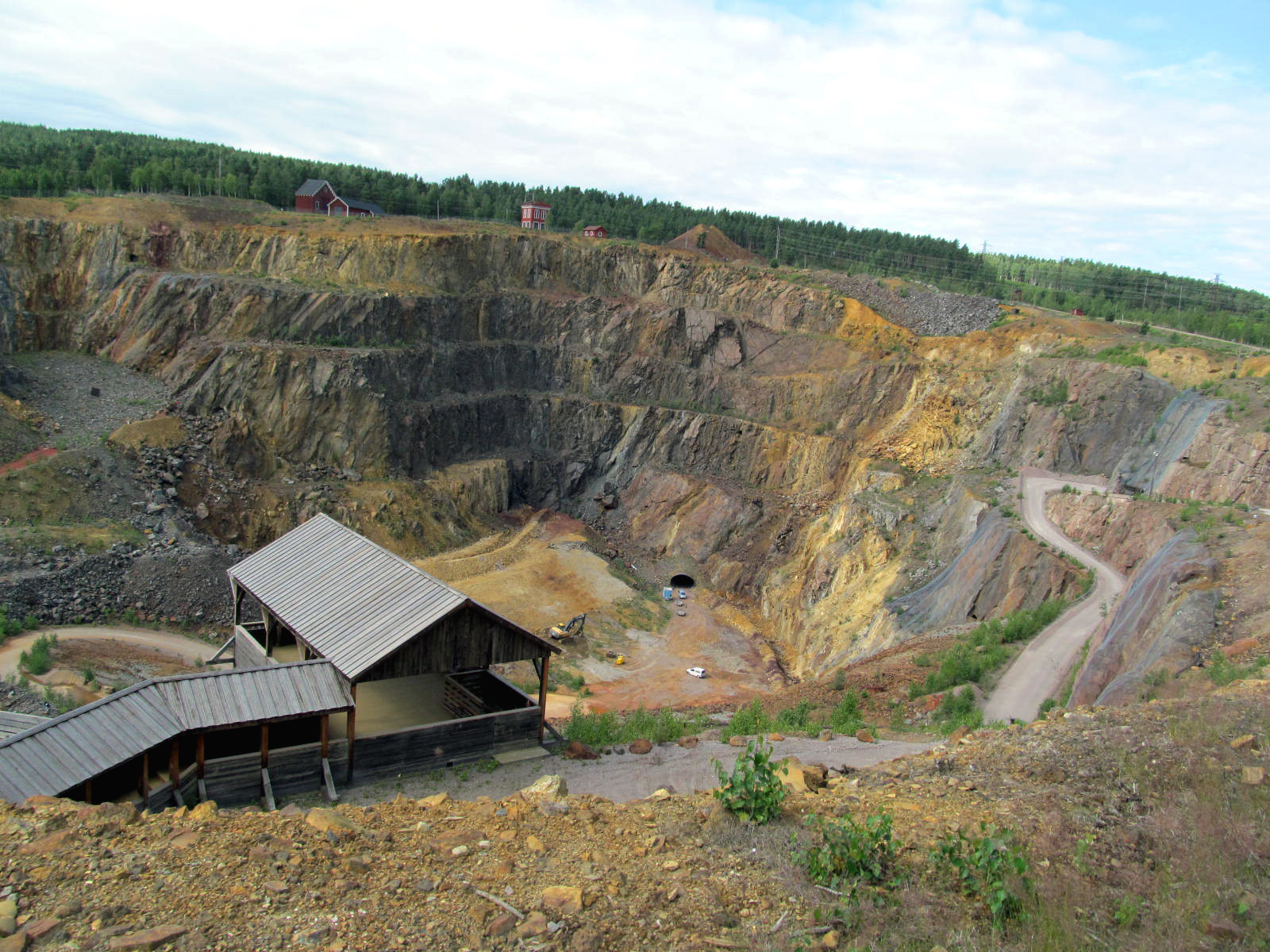
The pit was caused when mine shafts collapsed

Ready to go exploring underground!

Deep underground in one of the shafts
From Falun, we continued southeast to Uppsala where we found ancient burial mounds at Gama Uppsala aka "Old Uppsala". Tradition has it that this used to be the chief cult site for the Svear and the seat of their kings. There are 2000-3000 graves in the area with about 250 above ground in the mounds. The three largest mounds contain graves dating from the 6th century and are believed to contain the pyres of three kings.

Burial Mounds at Gamla Uppsala

A nearby stone church sits on a site that had a church on it from an unknown date. The current church dates from the 12th century and was the first cathedral in Uppsala as well as the residence of Sweden's first archbishop. Part of the original large church was destroyed by fire and a new cathedral was built in Uppsala. However, artifacts from the old church are still on display including the original crucifix from the 12th century and a baptismal font from the 13th century.
Church at Gamla Uppsala

St. George at combat with the dragon (1455-1469)
(The best preserved painting in the church)
 

Modern gravesites at Gamla Uppsala


We then drove on to downtown Uppsala which is Sweden's major university city--the university was established in 1477 and is the oldest Nordic university. We walked around the central part of the city and visited the Cathedral--a beautiful Gothic structure which was begun in the mid-13th century and completed and consecrated in 1435. It has been damaged by fire several times over the years, but remains an imposing building through rebuilding and restoration efforts that have been carried out. The Uppsala Cathedral is the largest church in Scandinavia with an external length of 118.7 meters (m) (391.7 feet), height of the spires 118.7 m, and height of the ceiling 27 m (89.1 feet).


Domkrykan (Uppsala Cathedral)


Mural in  Domkrykan


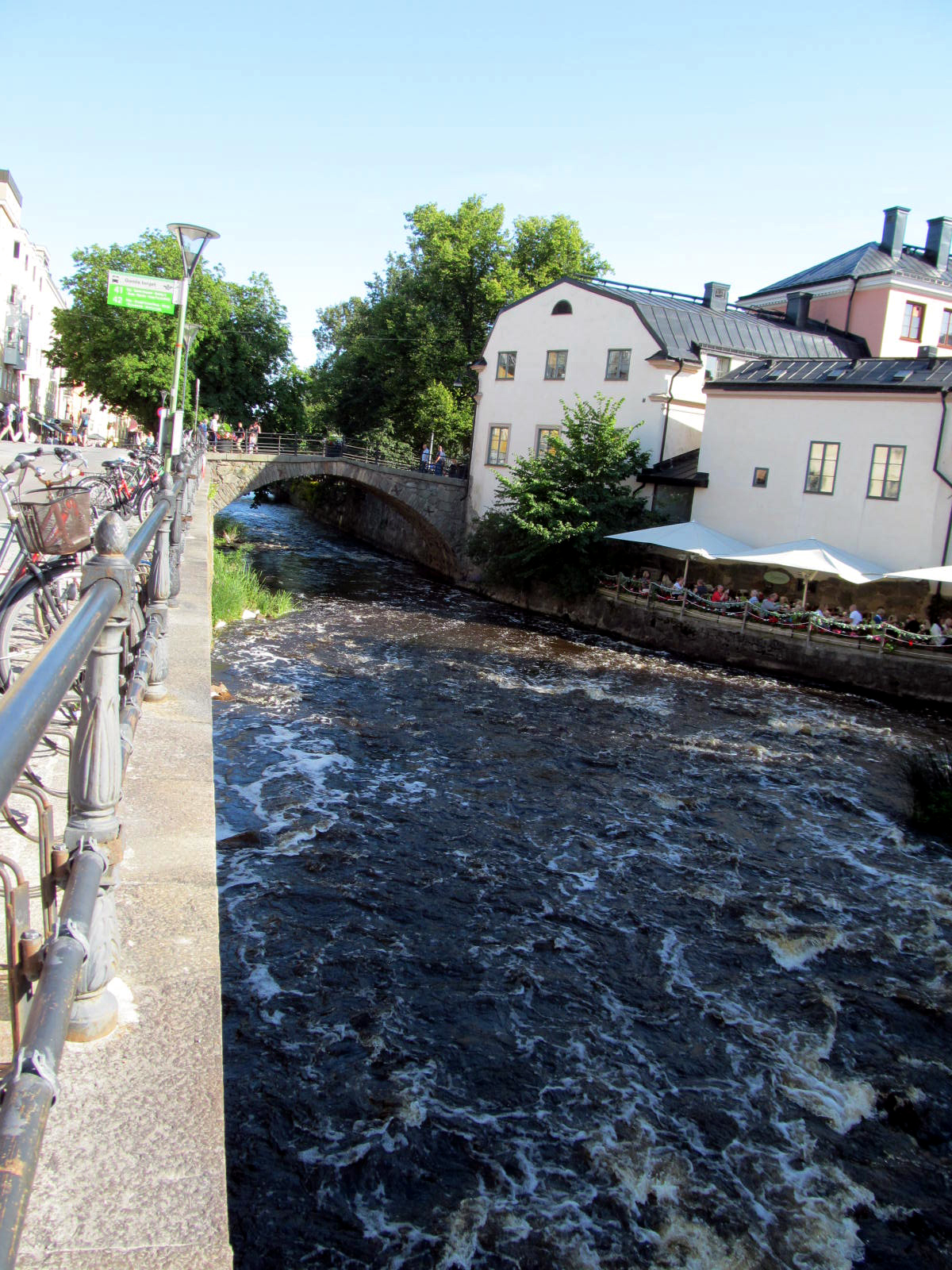
Above:  Two street scenes from Uppsala

11th Century A.D. Rune Stone

Before leaving Uppsala, and since we were in a shopping area, I had a mission to complete. It seems that there was a problem with one of my converters (used to convert 240 to 120 volts) last night and my battery charger no longer worked with electric power. This was serious since I use a LOT of AA battery power for the camera and the GPS unit. (We found out while driving to Uppsala that the 12V portion of the charger still worked in the car.) Even more serious, though, was the condition of my curling iron when I got out of the shower with the intent of using it to curl my hair. The unit had gotten so hot during the short time it was turned on that the plastic tip had melted where it was connected to the metal and the tip was hanging down at a 90 degree angle! This was not a good picture! So, before leaving Uppsala, we stopped in some stores to find a replacement. I found one that was too large, then found another in a different store that I thought might work and it was 50+ kronor cheaper. Bought it and was I ever in for a surprise when I opened the package that night! Instead of the metal plate to hold the hair on the rod, a glove was provided to hold the hair in place. Don't know if I will ever learn to use this contraption! (Note: After over a week of using the new unit, I still can't get a decent "do" with it. If anyone wants a slightly used 240V curling iron after this trip, let me know. <G> )

Uppsala was the last stop on this journey and we continued on to Jakobsberg. It was a very interesting two days filled with new sights, plus the added benefit of learning about the country while traveling with Mari-Anne and Gunnar.

JULY 27, 2012

Mari-Anne and I headed out mid-morning walking to the train station for the short ride into Stockholm where we boarded a sightseeing boat for a trip on Lake Malaren to Drottningholm. Along the way we passed many small islands with landmarks, businesses, and homes on them--a really beautiful trip on a wonderfully warm, sunny day. Mari-Anne is very familiar with all of this area and was able to "fill in the blanks" when I had questions that weren't answered by the onboard narrative.
Stockholm City Hall from the water
Stockholm Waterfront 
 After about two hours we docked at Drottningholm, which is included in UNESCO's World Heritage List, and which also serves as the official home of the Swedish royal family. Building of the current palace began in 1662 after the previous palace burned to the ground. It is a magnificent baroque building located in a beautiful setting!

Drottningholm
The surrounding gardens and parks are open to the public and are very nice. We watched the changing of the guard at the palace before entering the gardens.

Changing of the Guard


One unique building on the grounds is the Chinese Pavilion which was a birthday gift from the king in 1753 to his queen. The original pavilion didn't last and ten years later a new Chinese Pavilion was designed. During this period, there was a lot of interest in everything "Chinese" which had developed from the emerging East India trade.

Chinese Pavilion

Again, Mari-Anne knew exactly the perfect place for lunch in a secluded eatery next to the pavilion.

 
Our lunchtime entertainment!
We strolled back through the gardens after lunch and Gunnar picked us up for the trip home. This ended another wonderful day of seeing different aspects of the country. But I know there will be much more to come!

SATURDAY, JULY 28, 2012

We were all up early and ready to depart for our respective destinations. Mari-Anne and Gunnar were going to join their family on the coast northeast of Jakobsberg after dropping me off at the airport. I took a Norwegian Air flight to Oslo, Norway where it was raining when I landed. I had not set up a hotel transfer in advance, but our tour guide spotted me and I was able to ride into town in the bus she had arranged for others in our group. A note about the airport in Stockholm: everything is automated there. You print out your boarding passes and baggage tags at kiosks--and no one is there to help or to answer questions. Thank goodness Mari-Anne went in to show me the ropes! (I wouldn't be too surprised to see this lack of service personnel coming to the U.S. soon. I notice every time I fly that there are fewer ground personnel to assist passengers.) Then, going through customs and immigration in Oslo was also interesting. Since I had arrived from the "shaded area", i.e. Sweden, there was no inspection.

I checked in to the hotel and took a short walk to get a bite to eat since it was early afternoon by this time. The afternoon was spent doing some more exploring in the local area before it was time to get ready for the tour meeting. The group met in the early evening where we were briefed on what to expect, met other members, and finished the paperwork for the trip (not much). It is quite a varied group and everyone seemed quite nice. We are 44 total with 36 from the U.S., 6 from Australia, and 2 from New Zealand. There are 3 family groups along with 7 children. Everyone is eagerly anticipating the week ahead.


Saturday, July 28, 2012

Stockholm, Sweden: July 22 and 23, 2012

SUNDAY, JULY 22, 2012
The bags have been packed, the car loaded, Zia (my cat) petted one more time after I had found her "hiding place" for 40 minutes while I looked for her, my Mother received a kiss, and I was off to Sioux Falls, SD to board the plane to Stockholm, Sweden. Due to a "mechanical" problem, we didn't depart for Chicago until 2 1/2 hours past the scheduled departure time. But not to worry, I still have a couple of hours to make the plane in Chicago.

Just to back up a bit, I made a quick trip to Forest City, IA, early in the week to take in a day at the Winnebago Grand National Rally. Attendance was down some this year--and it was hot as usual--but it is always wonderful to see old friends there. Thank you, Laurel, for your hospitality; it was much appreciated. I drove back to Hurley Wednesday a.m. to find Zia was still not recovering well from what ailed her, so off to the vet (again) we went. Still couldn't figure out what was causing the fever and other problems so a different antibiotic was prescribed which seems to be working. Mom and I drove down to Yankton for a few hours on Friday and Saturday to see those gathered for the annual Rayburn Family reunion. Busy schedules and the hot weather kept attendance down some, but a good group made it. Speaking of hot weather, the temperatures in SD this past week ranged from about 100 degrees in Hurley (southeastern SD) to 110 in central and western SD. Heat indexes were WAY HIGH! The corn is burning up and the beans are showing stress. Needless to say, there won't be any bumper crops in this part of the country this year.

Now for a little background on this trip. When I was in the 5th grade (a long time ago <G> ) I was given the name of a Swedish girl to correspond with as a "pen pal". (I doubt this is done any more since I never hear the term now.) Her name was Mari-Anne and I began writing to her. Sometime later I received a letter from her and we continued to correspond until she was in college, after which contact between us was lost. She came across an old letter I had written in late 2010 and "found" me on Facebook in early 2011. We have since picked up our correspondence back and forth and I was so pleased to be able to finally meet Mari-Anne, her husband Gunnar, and a daughter Maria in AZ in May 2011 where we began discussing the possibilities of my coming to see them in Sweden. There is a lot more to this story that I won't write here, but it has been a very interesting and fun year re-connecting with her. You would not believe what close proximity we have been in SD and in AZ over the past 3 or 4 years but, since we weren't in communication, we did not know of the other's whereabouts.

I will fly all night on SAS Airlines, arriving in Stockholm about 7:50 a.m. Monday. As far as I can tell, there is a 7-hour time difference between U.S. CDT and Sweden's time. The next post will be from Sweden--assuming Mari-Anne and Gunnar don't keep me too busy to write and I can find a WIFI connection somewhere. If it becomes too much of a chore to post while I'm taking in the sights, I promise I will do a big post when I return to the U.S.

MONDAY, JULY 23, 2012
Well, the 2 hours I had in Chicago yesterday were just enough to make the boarding for the flight to Stockholm! The flight over was a good one with an on-time arrival. Mari-Anne and Gunnar were there to meet me and we drove to their home where I deposited my bags and we had lunch. (They live in Jakobsberg which is about 20 miles northwest of Stockholm.) We did some sightseeing in their neighborhood during the afternoon. They had expressed an interest in learning what geocaching is about, so we incorporated some of that in the afternoon, too. The first cache was close to their home, but it became quite problematical to find it. After spending some time walking/crawling through tall grass and brush on a very steep slope, we decided to leave that cache for a later day--if ever. <G> However, we did find two caches and I launched a travel bug named "South   Dakota Traveler #2" in one which was located on the grounds of a very old mansion.    We also walked to see the remains of a prehistoric fortification overlooking Lake Malaren--Sweden's third largest lake. The fort, named Gaseborg, was probably built during the late Iron Age (500-1100 A.D.) to supervise and control the waterway below. The view from here is beautiful! We wrapped up the sightseeing in the local neighborhood and, upon returning home, I went straight to bed--jet lag had finally caught up with me!


     Mari-Anne & Gunnar Stignas


 Logging the first cache found in Sweden 
This post is being written from Norway on July 28th. I have been plagued by computer problems all week after having used this new notebook computer exclusively for two weeks prior to departing SD to ensure that all the programs were working appropriately. Somewhere between Sioux Falls and Stockholm the Internet Explorer program went "haywire" so I couldn't get to Earthlink. Finally IE began working after several hours of working on it, then Word was bad. It cannot be opened, so I am resorting to WordPad to write the posts. I won't have spell check and the other features Word has to make a good document; however, I believe everyone reading this will bear with me and hopefully will forgive errors and omissions that may be present.


Sunday, July 15, 2012

SWEDEN AND NORWAY HERE I COME!


This is a test so I can see if I remember how to post to the blog <G> and to give all who read it an opportunity to familiarize themselves with how to get to the blog.

To recap a little, I am currently at my Mother’s in Hurley, SD (southeastern SD).  I spent the winter in Yuma, AZ before beginning my trip north in mid-March.  I enjoyed visiting friends and family along the way before landing in the SD Black Hills for about 6 weeks in May/June—and again visited with friends and family there.  I was joined by Richard and Essie McCloskey the last week and we did a whirlwind tour of the Hills’ 
ESSIE AND RICHARD MCCLOSKEY WITH CAROL
highlights to the tune of 10-12 hours a day.  We then caravanned to Hurley where they spent a couple of days before journeying on east.  As I write this (July 15th) my days are filled with trip preparations, doing jobs for Mom, etc.  This week I will attend Winnebago’s Grand National Rally Mon. and Tues. in Forest City, IA and a family reunion at the end of the week in Yankton, SD before climbing on a plane out of Sioux Falls on Sunday, July 22.  It is a very busy time but a time filled with anticipation of coming events!  Stay tuned…
MT. RUSHMORE

Friday, June 13, 2008

NORTH TO ALASKA!

JUNE 1-14, 2008

I spent June 1-6 preparing for the Alaska trip, cleaning out extra “stuff” from the coach and depositing it at Mom’s house in Hurley, SD. Then I reorganized what was left—hope I can find everything when I need it! Weather continued to be very unsettled with thunderstorms and tornado watches the norm all week. There is certainly a lot of water standing in the fields. My brothers will not be able to plant a lot of the land they farm and much of their bean and corn acreage is being flooded out.

I departed Hurley Saturday June 7th, headed north. I’d hoped to get north during a brief break in the weather and drove as far as Jamestown, ND—a 340 mile drive. The following day was a 447 mile drive to Moose Jaw, Saskatchewan through lots of flat farm land interspersed with rolling hills. I saw a lot of waterfowl both days, including quite a few white pelicans which reminded me of winter in Fulton, TX. I wondered if they came from down there. The border crossing at Portal, ND was uneventful and swift. Soon after crossing I drove through a large area of surface coal mines near Estevan, SK. From the road, it didn't appear that they were digging very deep to mine. Weather was unsettled this day and I drove through rain. A tornado watch was in effect for the area of SK I traveled through and one touched down near Weyburn after I’d driven through there. I still haven’t escaped the bad weather! June 9th I drove 490 miles on back roads to Edmonton. It was a long day through flat farmland and rolling hills. Fields of grain were large and farms looked well cared for all along the way—no rundown buildings, etc. After driving through about 150 miles of rain, I finally arrived in Edmonton—after snaking my way through the confusing highway system on the south side of town. No kidding, using 4 maps plus the GPS, I still ended up in a residential area. Some new roads weren’t on the maps; others didn’t have route numbers on them, etc. All


--Coal Mining--


in all, the most confusing highway/street system of any town I’ve been in. I decided that the easiest way to get to this campground on the west side of town is to take the Yellowhead Highway—at least that is noted on all the maps!
I spent June 10-14 in Edmonton. It was quiet in the park and I was able to have the needed uninterrupted time to work on the coach and prepare for the caravan, in addition to doing some limited sightseeing. The first full day was supposed to be decent weather-wise, so I drove about 45 miles south to the Reynolds-Alberta Museum and the Canada Aviation Hall of Fame at Wetaskiwin. I spent most of the time there in the aviation museum and enjoyed seeing the display describing a sister Ninety-Nine, Rosella Bjornson’s career. She has had a very interesting career as a ground breaker in Canadian aviation and is enshrined in the Hall of Fame. Our early years were very similar in that our families were both involved in the Flying Farmers organization and we both soloed in a Cessna 170. (Rosella and her husband, Bill, came to the RV park a couple of days later and we had a nice visit.) By the time I finished the aviation museum, the weather was looking very threatening. I did a quick walk through of the other museum and headed back to the coach. The Reynolds-Alberta Museum really deserves a return visit. I heard on the drive back that tornado and thunderstorm watches had been issued for this whole area of Alberta and the weather really did look threatening. We had some heavy rain at the park and a tornado touched down about 20 miles west of here. I’m still not out of the severe weather!!!

The Tailenders for the caravan, Bob and Marilyn Beardsall from Ontario, arrived during the week and we spent some time making plans for the upcoming caravan. I also visited the West Edmonton Mall which is one of the largest malls in the world containing over 800 stores, over 100 eating establishments, and 9 major theme attractions. Since I’m not a shopper (Where are you going to put “stuff” in your permanent house on wheels?), I didn’t spend a great deal of time there. Many of the shops are the same that you see in the States, but the other attractions in the mall are something else.

Wednesday, June 11, 2008

WINTER IN TEXAS, THEN NORTH TO SOUTH DAKOTA

JANUARY THROUGH MAY, 2008

The first four months of 2008 found me in Texas where I was in the Fulton/Rockport area until mid-March. I was interested in checking out southern TX during a winter and found that the Gulf Coast area north of Corpus Christi was cloudier, wetter, and colder than I anticipated it would be. However, I enjoyed camping there and seeing the area with the 3 other “Winter Texan Winnies” (see our blog describing our trip across Texas and December doings at http://wintertexanwinnies.blogspot.com/). We all drive Winnebago motorhomes and enjoy seeing the country in them. Our experiences during the course of the winter were special and made for more than a few laughs. Other special times during the Fulton/Rockport stay included having my Mother, Betty, along from late December until mid-March. Her cat, Molly, came along for company for Zia; however, I’m not sure how much they really appreciate each other’s company. Carol Clarke, from Salt Lake City and Sandi Koch, from the Tacoma, WA area, each came for a week and Joyce McCollough, Livingston, TX, came for several days just before I left town. It was wonderful visiting with each of them and helped the cold wet days pass faster. My brother Steve and his wife Jan came for a week in March and took Mom and Molly home to SD. We had the best (of 4) bird watching boat ride while they were there—about 30 minutes were spent watching mating dances of 3 whooping cranes. This was awesome! Roberta’s Mother, Evelyn, arrived for a visit with Roberta just before Mom went north, so the four of us were able to have a short visit and renew friendships made in Alaskalast summer. Short visits were also enjoyed with other folks as they passed through the area. New friends and acquaintances were made at Driftwood RV Park in Fulton and I look forward to seeing them in the future. The park is quite small so a real sense of “community” is present.
Driftwood RV Haven Friends


Birding is big along the Gulf Coast and we weren’t disappointed as we watched large numbers of waterfowl daily. We enjoyed watching the pelicans dive into water for their food—actually they looked more like they were crashing into the water! Egrets, herons, ducks (many kinds), cormorants, roseate spoonbills—all were readily available to watch. However, the highlight for me was each time we went on the boat trip to watch the whooping cranes. They are such large, stately, beautiful birds with 7 ½ foot wingspans! Their winter range is just a few miles northeast of Fulton in the Aransas Nat’l Wildlife Refuge and the flock is increasing in size nicely after almost becoming extinct.
THOSE MAGNIFICENT WHOOPING CRANES!


Several short trips were taken from Fulton including one back to Goliad State Park, a drive to Port Lavaca, a day at the King Ranch and Kingsville, an overnight trip to South Padre Island and a drive inland along the Rio Grande cities in south Texas (does that country ever show signs of development!), trips to Padre Island National Seashore, a craft fair at Robstown where I met up with friends seen earlier at the fair in Fredricksburg during our November stop, trips to Aransas Nat’l Wildlife Refuge, and several trips down to Corpus Christi.

Roseatte Spoonbills (Left)Rookery with many types of birds (right)


.............................GREAT BLUE HERONS.............................


...................BROWN & WHITE PELICANS....................
I headed to Pharr, TX, the 3rd week of March where I was able to visit with Jim and Judy Peitz for a few days before they headed north to their “stick” home. We had a nice visit and they showed me the “lay of the land” in that part of the Valley. I thoroughly enjoyed the warmer temperatures and blue skies—in spite of some windy days. The Valley has really been promoting birding and there are incredible opportunities to see birds there that are seen no where else in the U.S. I definitely would like to return there for at least part of another winter to spend more time exploring the various bird refuges that have been established and which have wonderful guided tours.


GREEN JAYS


LEFT: HOODED ORIOLE


RIGHT: MOCKINGBIRD

.......GREAT EGRET & CRESTED CARACARA ......


From Pharr I headed north to Choke Canyon State Park near
Three Rivers, TX, about 85 miles southeast of San Antonio where I stayed a couple of weeks. This is a wonderful park with neat views, good fishing in the reservoir, and very good birding. Oh, yes, they also have alligators there! This is the farthest inland point the ‘gators come to in Texas—and I can vouch that they are there. Zia met her first armadillo while here--one came around our camp during several evenings. Clancey Maloney from NM was able to join me for a short visit here. All too soon, it was time to leave Choke Canyon (I hope to go back there!) and head for San Antonio where I was scheduled to host WIT (Winnebago-Itasca Travelers) Tours’ rally during that city’s Fiesta week. We had a wonderful rally—it was really a fun group to be with. The Fiesta celebrates the various cultures in Texas and highlights the remembrance of the heroes who fought in the battles of the Alamo and San Jacinto which led to Texas’ independence from Mexico. Rally attendees participate in Fiesta activities in addition to seeing various interesting venues in the San Antonio area as well as having a day-trip to the “Hill Country” in the Fredricksburg area. While in San Antonio, I agreed to lead a caravan for WIT Tours to Alaska this summer. This was a last-minute change in plans for me as there were only a few weeks to wrap up the rally, finish a project for WIT Tours, get the coach serviced, and prepare for the trip. It would prove to be a very busy 6 weeks!


With the rally a wrap, I headed north to Wichita where I parked for a couple of weeks. The main reason for the stop, in addition to seeing my brother, Dick, and his family was to attend niece Rachel’s graduation from high school. Queena and her girls came down early from SD, and Heather was over early from Kansas City. Mom, Jan, and Nicki also came down from SD for the graduation. Although it was a smaller than planned family gathering because my SD brothers were busy planting corn in between rain storms, a good time was had by all. The time here gave me valuable time to wrap up rally reports and work on other “stuff” to prepare for the upcoming Alaska trip.

I departed Wichita in mid-May with Mom and her cat, Molly, on board the motorhome. We headed to Des Moines, IA, where I had an appointment at the Freightliner dealer for an inspection of the chassis. One day’s work turned into 2 days and at 9:00 p.m. the second night we departed for Forest City, IA, where I had an appointment for service with Winnebago. We did manage to tour the IA capitol building while in Des Moines—it is an impressive building with 29 types of marble used in it’s construction—and watched a couple of horse races at the race park adjoining Adventureland where we camped. What I thought might be 3 days work at Winnebago turned into a longer stay that was interrupted by the long Memorial Day weekend. I worked with folks at the WIT Tours office on a project during part of this time and Mom and I traveled to Mason City one evening to see her brother, Bill, and his wife Phyllis. This was a bittersweet visit as Bill was in very poor health and passed away a couple of weeks later. Mom and I took the car and went to Hurley the Saturday before Memorial Day so we could decorate graves, etc. They had been having a lot of rain in SD, and that, coupled with cool weather, resulted in few flowers available for the decorations. I returned to IA on Memorial Day afternoon as work on the coach was to continue through the week. It was finally finished on May 30th and I drove back to Hurley on the 31st.

Wednesday, November 28, 2007

AUGUST 27-SEPTEMBER 19: DEASE LAKE, BC TO ALBUQUERQUE, NM

CASSIAR HIGHWAY: DEASE LAKE TO STEWART-HYDER
August 27th saw us driving about 250 miles down the Cassiar Highway and taking a cutoff to Stewart, BC, where we set up camp. We had a lot of gravel going south out of Dease Lake with road construction going on where the land slides had occurred earlier in the summer. We encountered one sizeable stretch of gravel road that was unmarked, had no shoulders, and dropped straight down off the side for a considerable distance. Eventually, we got on good paved roads. This was a beautiful drive through the coastal range with lots of green vegetation as we got into the hemlock/cedar forest area. Continuing southward, the mountains became covered with vegetation to the tops and the trees became much taller—not many bald mountains in this area of the trip. Some of the taller mountains still had patches of snow which provided a wonderful contrast to all the greenery. As my notes from this day said, it was an incredibly beautiful drive. The spur road into Stewart was in a narrow canyon with lots of vegetation, hanging glaciers up in the mountains and one large glacier (Bear Glacier) that terminated in the valley. We set up camp and drove to Hyder, AK, which adjoins Stewart located at the head of the Portland Canal (think “fjord” when you read “canal”). The towns are very different—Stewart has paved streets, numerous businesses and places to stay while Hyder, aka “The Friendliest Little Ghost Town in Alaska”, has dirt streets, is much smaller, and doesn’t have much in the way of businesses. Hyder is at the end of the Alaska and has a definite “outback” feel to it. We drove to the famous bear-viewing area outside Hyder where we were treated to quite a show put on by three grizzly cubs and a sow. We watched the bears for probably 1 ½ hours and also saw bald eagles in the area.

August 28th and 29th were spent in Stewart-Hyder. We went to the bear viewing area and watched grizzlies and black bears eat salmon and low bushes again. They were fascinating to watch up close and didn’t seem to mind the observers on the viewing stand. We also went to a neat museum in Stewart and to Hyder’s Glacier Inn where we didn’t get “Hyderized”, which consists of drinking straight everclear, but we did enjoy a drink to celebrate our time and experiences in this neat, out-of-the-way part of Alaska. This area is a definite “must-see” for anyone traveling the Cassiar. One note concerning weather here: it is very changeable so if you see an opportunity to take pictures or observe a landmark, take advantage of it at the time because the opportunity may be gone in a few minutes and may not present itself again for days.

SMITHERS AND PRINCE GEORGE, BC
August 30th found us back on the road headed south. We stopped at Gitanyow a small Indian Village with one of the largest concentrations of standing totem poles in northwestern B.C. The totems are really works of art; however, I didn’t learn much about interpreting them on this trip. Services were very limited here near the end of the Cassiar Highway. The Cassiar Highway ended west of Smithers, BC, and we were on the Yellowhead Highway into the Smithers area for the night. I unhooked my car to use for local travel and found, much to my chagrin, that I had a very bad vibration. I wasn’t sure what was causing it and I hadn’t had it when I hooked up after the drive to Telegraph Creek; however, it was the kind of vibration that loosens your tooth fillings! Since Labor Day weekend was coming up, I had all kinds of thoughts about being stranded in Smithers for several days. Fortunately, I was able to find a garage early Friday morning, the 31st, and they were able to cure the problem. I had a LOT of mud impacted in and around the wheels. Taking off all the wheels, cleaning and rebalancing them, cured the problem. (Note: I was still cleaning mud from that trip packed under the car weeks later after getting into the Lower 48!) We departed Smithers after my “problem” was solved and stayed in Prince George, BC over the Labor Day weekend. Terrain became much more rolling as we drove south on the 31st. Lodge pole pine in this part of BC had been infested with a bark beetle causing significant loss of timber and a lot of dead trees for miles. We also saw thousands of acres of fir trees devastated by the beetles.


CLINTON, BC
September 1 and 2 were down days spent in Prince George doing laundry, cleaning the inside and outside of the rigs, etc. Monday, September 3rd (Labor Day in Canada and the U.S.), we headed south on the Caribou Connector (Hwy 97). This was our last full day for Roberta and me to be traveling together as we headed toward Clinton, BC. We were in the Fraser River Valley much of the time and it was a beautiful drive through rolling countryside with more farming and pasture land evident than we had seen for some time. I picked up some fresh sweet corn from a roadside stand for dinner—it sure tasted good! Trees were turning—lots of yellow and gold evident. We noticed the drivers in this part of BC pretty much ignored yellow no-passing lines on the road. If they wanted to get ahead of us, they passed whether or not there was a yellow line present! Also, the Caribou Connector didn’t have any kilometer markers so we relied on my GPS for location information along this stretch. We checked into the campground at Clinton in the early afternoon and had some time to get things sorted out before going our separate ways. Weather was nice so we grilled steaks and had sweet corn and ice cream for our last dinner together on this trip. The evening was spent reminiscing about the fantastic 4 ½ months we had just had. I was able to use my Verizon card for an internet connection here—Roberta had been told by Verizon before we left that she could use the card any place she had service and that it wouldn’t cost extra. I decided to give it a try and successfully logged on, keeping the session short so if there would be any “hidden” charges they wouldn’t be too steep. Well, when I finally got my bill for that session, I found that I had been charged an “international roaming” charge—and it wasn’t cheap. Lesson learned…

BACK INTO THE U.S. (Oroville, WA, to Albuquerque, NM)
Tuesday, September 4th, found us headed south once again and we parted company at Cache Creek after 7374 miles driven on the journey since our departure from NM on May 7th. Roberta headed towards the Seattle area and I went towards the Wenatchee, WA, area. I had a beautiful drive through the Kamloops area and along long narrow lakes, including Okanagan Lake, before crossing back into the U.S. at Oroville, WA. There were several long climbs and descents on this stretch—6% climb for 15 miles in one area. One of my first stops after crossing the border was at a fruit stand to pick up fresh fruit and vegetables which I really missed this summer. The night was spent at a very nice state park on the shore of the Columbia River near Wenatchee. I took two-lane roads south through central WA, following the Columbia River much of the way. Stayed overnight near Quincy, WA, on the 5th. The drive the past two days was very pretty through WA—I was struck by the large number of vineyards along here. I knew winemaking was getting strong in WA, but I was really surprised at the large number of acres that have been planted to grapes. September 6th I continued on country roads until getting on I-84 near the WA/OR border, and then continued on to Boise, ID, where I found a Wal-Mart to park in for the night. The 7th found me up early and headed for Salt Lake City, UT. I stopped at Burley, ID, for a nice visit with friends Marilyn Sidwell and John Jones. We all travel in motorhomes but I thought I’d take a chance to see if they were in the area. They were and it was really nice to meet up with them for a short visit.

I left Burley and traveled on down to Salt Lake City where I stayed on the 7th and 8th. While there, I had a nice visit with Frank and Shirley Robles and with Carol Clarke. Wow! Has that area changed! It is one big city from near Brigham City to Spanish Fork, UT. September 9th saw me driving on towards Grand Junction, CO, to visit an aunt and uncle, Harve and Peg Huffer, and cousin Dave and his family. I had a wonderful short visit (and a tremendous lunch, too) with Rick and Ardith Keppler in Price while enroute to Grand Junction. After one night in Grand Junction, I was up early and headed for Bennett, CO, where I parked at nephew Paul’s off and on for the next week. It was good to see Paul, Jenn, Lexi, and Conner and I appreciated, once again, their hospitality and their RV parking setup. During this period I moved the coach to Boulder where I parked in a hotel’s parking lot for five nights while attending the Ninety-Nines’ annual meeting. These conferences are always enjoyable as women pilots from around the world gather for several days to do the business of the organization, attend seminars, and catch up on what has happened in our lives over the last year. Soon everything was done in CO, so it was on to NM. I stayed in Santa Fe on the 18th and had an enjoyable evening of catching up with friends Judy Waite and Nancy Evey. I arrived in Albuquerque on September 19th, 4 ½ months and 9735 miles (on the coach) since leaving there on May 7th.

WHAT A TRIP!
What a trip this was! Would I do it again? You bet—I’d do it in a heartbeat! Was it too long? No way. Four months is just right—we were able to see just about everything we wanted to see, we weren’t on a schedule, and we had ample “down time”. Where would I like to spend more time (besides in Alaska)? In the Yukon—people there were sooo nice and sooo proud of their part of the country. Would I advise others to take the drive? Absolutely! Driving yourself is the only way to really see the north country, plus you get to explore areas and see things that aren’t on a cruise ship’s or bus company’s set itinerary. Roads are better than adequate, although you do need to slow down in some areas, and fuel is readily available. Just plan to drive on the top half of the tank. One of the real bonuses of this trip was meeting old friends along the way, both in and out of the motorhome community, and making new friends in the far-flung places. I look forward to seeing all these friends in the north country again in the not-too-distant future.

Two guides that were indispensable on the trip were The Milepost and Traveler’s Guide To Alaskan Camping by Mike and Terri Church. RVing Alaska By Land And Sea by Bill and Jan Moeller was also helpful. However, the most help we received came from friends and acquaintances that have made the trip, some of them numerous times. You all know who you are so I won’t list names here. I just want to extend a Heartfelt THANK YOU! Your willingness to share added immeasurably to the success of this trip and I cannot thank you enough. I hope that I can return the favor by helping others who are thinking about making their dream trip as much as you helped me with mine.